



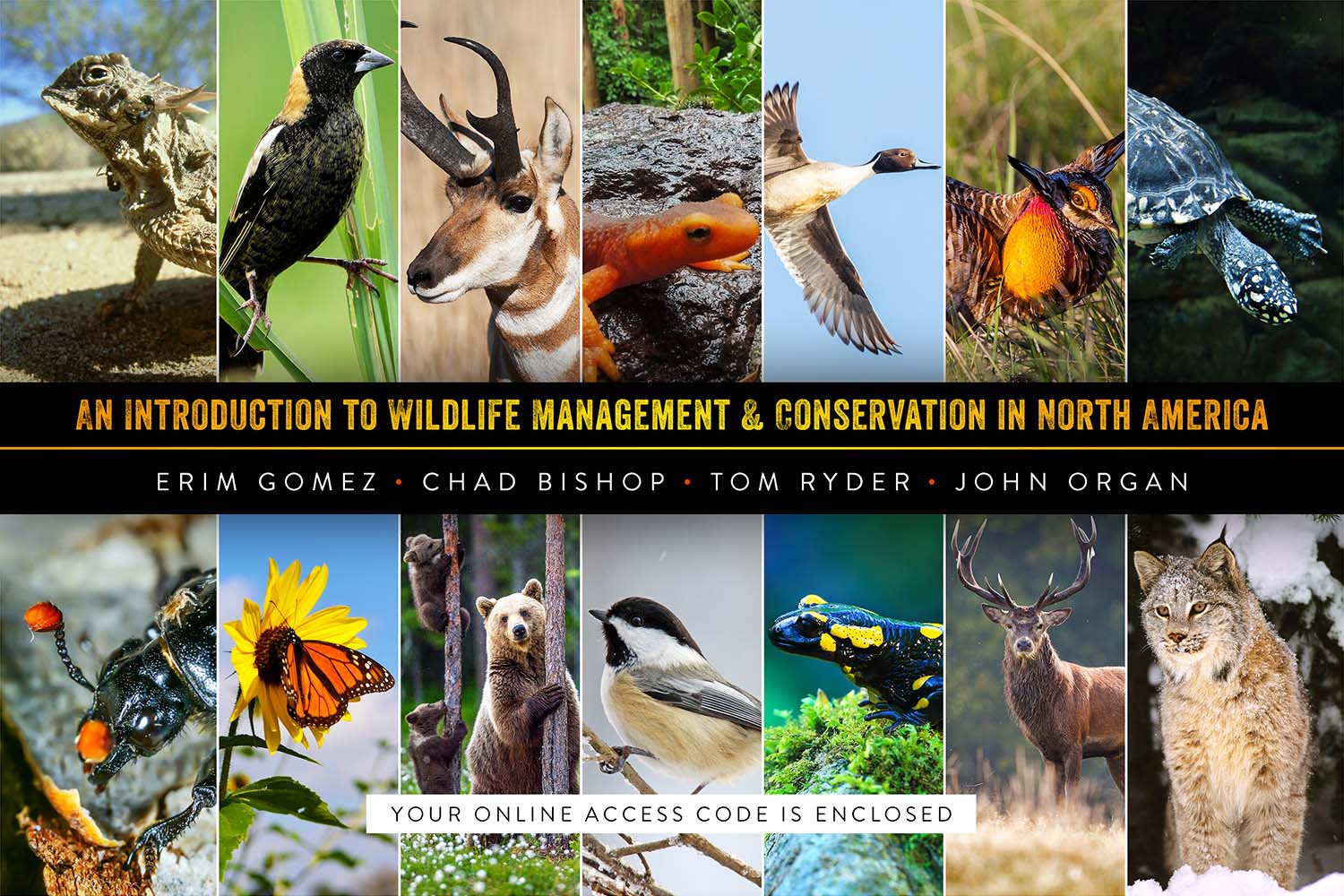
This online and interactive text is geared toward the introductory student in wildlife biology in the US. Thousands of students take introductory courses in wildlife at colleges and universities each year. There is a need for a comprehensive, contemporary introductory text on wildlife conservation produced in a manner that is engaging to students. Some of these students are committed to pursuing careers in wildlife biology, while many others are uncertain as to their future plans. In some cases, non-wildlife majors take these courses because they are interested in wildlife and want to learn more about it.
The information presented to students in these classes directly influences whether students will go on to pursue a degree and, eventually, a career in wildlife. Equally important, these courses influence students’ understanding and appreciation of the wildlife profession. For some, these courses serve as the only formal education they will receive in wildlife biology, management, and conservation. Therefore, our aim is that this introductory wildlife text will provide an opportunity to educate and inform students and in turn influence their subsequent understanding and views of wildlife conservation. In service of this goal, editors and chapter authors have developed an interactive and engaging online textbook. This textbook includes video links, web links, hover definitions, polls, discussion forums, and online quizzes.
Historical Foundations
Chapter 1: Melding Past, Present, and Future: The Importance of Tribal Management in Wildlife Conservation and Management
Mateen A. Hessami, Ty J. Werdel, Serra J. Hoagland, and Michel T. Kohl
Chapter 2: Western Culture: Historical Wildlife Management and Value Orientations
John Organ and Richard E. McCabe
Chapter 3: Establishment of the Wildlife Management Profession and Environmental Movement
John Organ and Richard E. McCabe
Chapter 4: Aldo Leopold and A Sand County Almanac: Key Concepts and Historical Significance
Thomas J. Ryder and Daniel J. Thompson
Chapter 5: Environmental Economics
Joe Kerkvliet
Contemporary Wildlife Conservation and Management
Chapter 6: Present Day Wildlife and Natural Resource Issues
Patrick Lederle, Ann Forstchen
Chapter 7: Human Dimensions of Wildlife
William F. Siemer, Daniel J. Decker and Shawn J. Riley
Chapter 8: Careers in Wildlife Biology and Closely Related Disciplines
Chad Bishop, Erim Gómez, John Organ, and Tom Ryder
Chapter 9: Conserving and Managing Wildlife and Natural Resources: Who Does What?
Christian A. Smith and Dean G. Smith
Chapter 10: The Global Trade in Wildlife and Wildlife Parts
Salvatore M. Amato
Chapter 11: Population Dynamics: Contemporary Wildlife Management and Conservation
Joshua J. Millspaugh and Paul M. Lukacs
Chapter 12: Applying Key Concepts: Management of Harvested Species
David A. Haukos
Chapter 13: Conservation and Management of Endangered and Imperiled Species
Jonathan R. Mawdsley
Chapter 14: Capture and Monitoring Techniques Used to Study and Manage Wildlife
Chad Bishop and Victoria J. Dreitz
Special Topics
Chapter 15: The Endangered Species Act: Historical Significance and Contemporary Implementation
Chris Segal
Chapter 16: The Endangered Species Act: Protecting Wildlife Species from Extinction
James R. Lyons, Christopher E. Seagal, and Lowell E. Baier
Chapter 17: Environmental Economics
Joe Kerkvliet
Chapter 18: International Wildlife Conservation – Challenges Do Not Stop at the Border
John L. Koprowski and Maria Vittoria Mazzamuto
Chapter 19: Walking the Fine Line: Science and Advocacy
Chad J. Bishop and John Organ
Looking Forward
Chapter 20: Enhancing Diversity
Erim Gómez
Chapter 21: Future Conservation Challenges
Steve Williams and Ronald J. Regan