



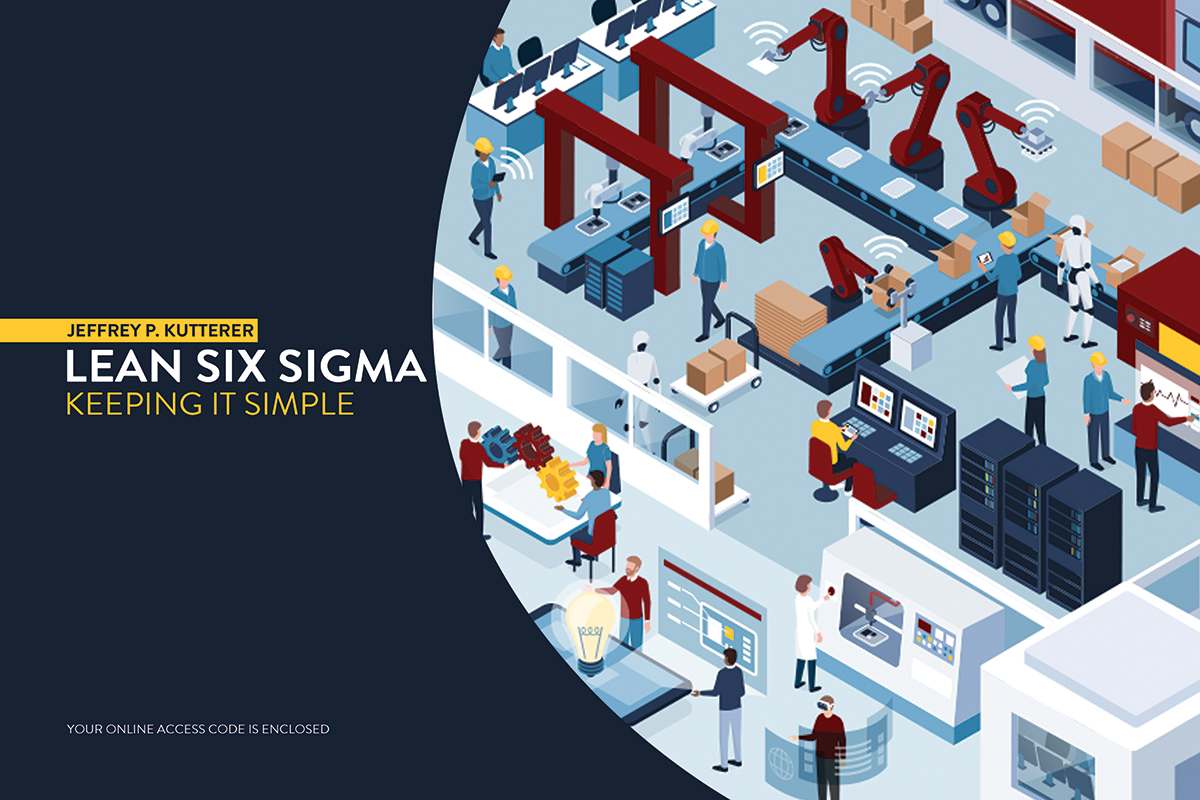
Lean Six Sigma; Keeping it Simple is an active learning guide for students to experience just how simple and easy lean six sigma can be.
This textbook was written for everyone who either has an interest in continually improving, operating efficiently and/or conserving resources. Lean Six Sigma is not just for manufacturing but can be used in all walks of life.
Lean Six Sigma; Keeping it Simple has three sections:
- Getting to Know Lean Six Sigma
- DMAIC-Define, Measure, Analyze, Improve, and Control
- A Summary Kaizen section.
In Getting to Know Lean Six Sigma, students get introduced to Lean Six Sigma, Lean Concepts, Lean Culture, Team Building, and Hoshin Planning. In DMAIC, students learn about the DMAIC process and the various tools that are used in each of the five steps of Define, Measure, Analyze, Improve, and Control. A few of the tools covered are the Seven Basic Quality Tools, Voice of the Customer (VOC), Value Stream Mapping (VSM), Visual Controls, 5S, Design of Experiments (DOE), Quality Control Plans, Statistical Process Control (SPC), Takt Time, Jidoka/Poka-Yoke, Total Productive Maintenance (TPM), Single Minute Exchange of Dies (SMED), Kanbans/JIT, and Root Cause Analysis (RCA) tools such as 5 Why Analysis, Fishbone diagrams, Scatter diagrams, and Control Charts just to name a few. The Kaizen section is a summary section that covers continuous improvement, zero defects, waste, the rules of kaizen, the 5 key performance measures, Risk, Issues, and Opportunities (RIO), and the building blocks of kaizen.
Section 1: Introduction
- Chapter 1: Lean Six Sigma Introduction
- Chapter 2: Lean Concepts/Lean Production
- Chapter 3: Lean Culture/Team Building
- Chapter 4: Hoshin Planning
Section 2: DMAIC; Define, Measure, Analyze, Improve, Control
- Chapter 5: Define
- Chapter 6: Measure
- Chapter 7: Analyze
- Chapter 8: Improve
- Chapter 9: Control
- Chapter 10: Control Continued
Section 3: Kaizen
- Chapter 11: Wrapping it All Up